Content Recommendation
A recommendation engine grounded in a buyer journey I built myself.
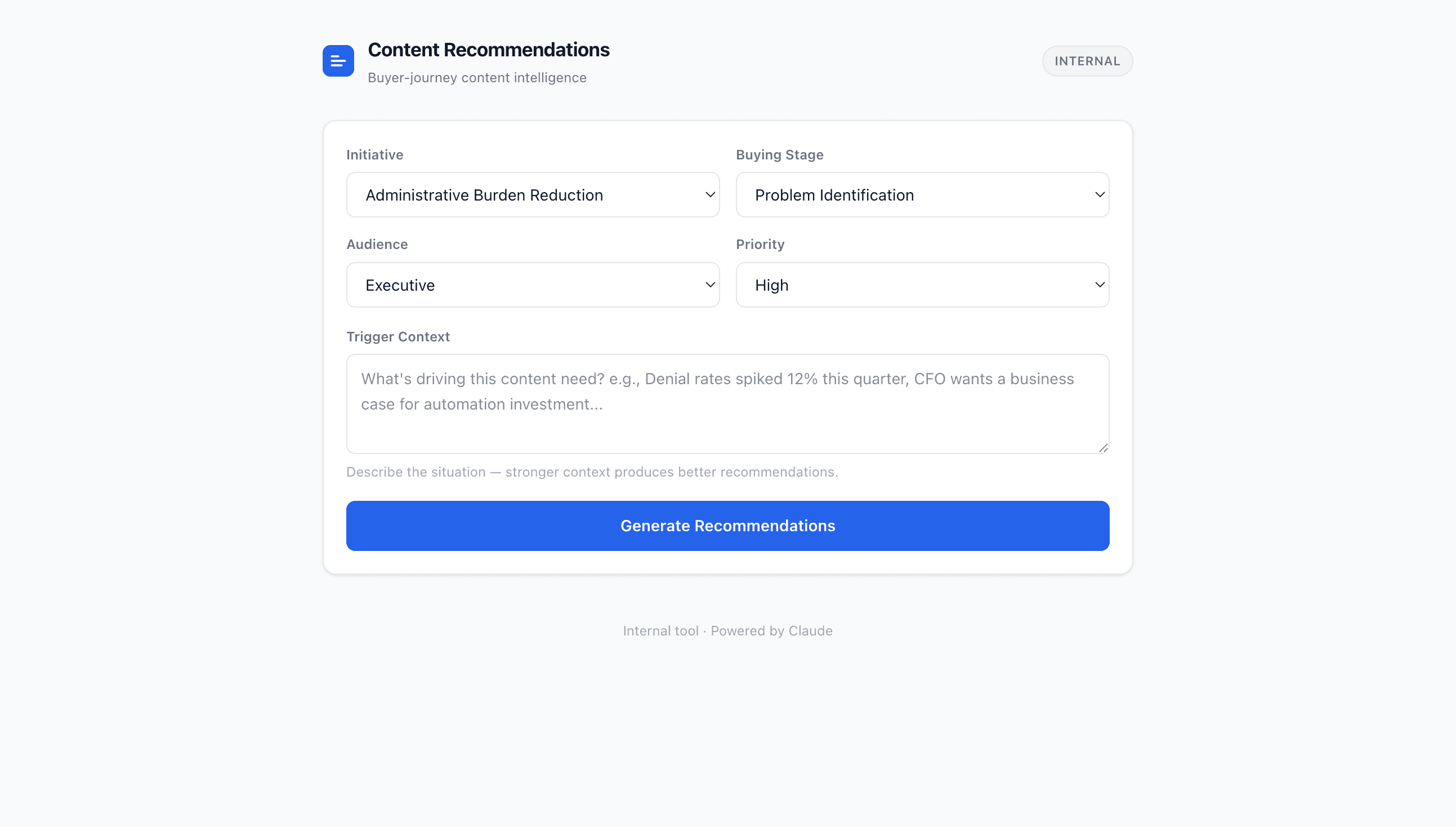
Stakeholder, stage, and objection in. Ranked recommendations with reasoning out.
Sales doesn't have a content problem. They have a content retrieval problem.
Marketing produces hundreds of assets, organizes them in a drive nobody opens, and reps end up sending the same three PDFs they always send.
I built this to close the gap between the buyer intelligence work I was doing (personas, stages, objections, stakeholder maps) and the content that should show up at each moment. You tell the app which stakeholder you're selling to, what stage the deal is in, and what objection is blocking you. It returns ranked assets with reasoning.
Production web app. Not a prompt template.
Content recommendation is an unsolved problem in B2B.
Libraries grow faster than they're organized
Tagging systems rot within a quarter. The asset that was perfect for a CFO objection six months ago is now buried under three rebrands of newer material.
Reps default to what they remember
They don't search. They send the last thing that worked. 80% of content never gets used. The 20% that does is often outdated.
The match is multi-dimensional
A one-pager that works for a CIO in shortlist doesn't work for a CFO in early problem identification. Most systems solve one axis; the real answer needs all three.
The answer is three axes at once, not one.
The buyer journey architecture I wrote is the scaffold. The app reasons across all three axes simultaneously, not in sequence.
Stakeholder
Role, authority, primary success metric, known objections. The person the asset has to convince.
Stage
Where the deal is in the buyer journey. Problem identification, solution exploration, requirements, shortlist, purchase.
Objection
What's actually blocking the deal right now. Cost, implementation risk, integration, timing, authority.
Inputs in, ranked recommendations out.
Data layer
Content library
Titles, descriptions, tags, stakeholder fit, stage fit, objection fit.
Buyer journey context
Stages, stakeholder power maps, observable signals, common objections.
Persona + positioning
Stored brand context that scopes the recommendation reasoning.
Intelligence layer
Azure + OpenAI
Reasoning engine evaluating match strength across all three axes simultaneously.
Confidence scoring
Every recommendation comes with a numeric confidence, not just a ranking.
Reasoning output
Plain-language explanation for why each asset surfaced. Reps can trust or question it.
Output layer
Ranked recommendations
Primary list of assets with confidence scores attached.
Alternative suggestions
Surfaced when top-match confidence is low.
Gap flags
When the library has no good match for a scenario, the app says so.
The tool is live. Go use it.
Running in production against a real content library. Opens in a new tab.
Live URL
content-recommendation-rho.vercel.app
AccessPassword: marketing
“Hire me and within 90 days I'll have a version of this running against your content library and your buyer journey.”
The architecture is the IP. The app makes it usable.
The recommendations are grounded in the buyer journey architecture, not in keywords. If a rep tells me they're in a shortlist evaluation with a CFO worried about implementation risk, the app doesn't hand them whatever has “CFO” in the metadata. It reasons across the stage, the stakeholder, and the specific objection, and ranks the assets that map to all three.
I built this after I built the buyer journey. The architecture is the intellectual property. The app is what you build when you're serious about making the IP usable.
A lot of PMMs produce personas and journeys. Few close the loop to the content layer. That's where deals actually get won or lost.
A senior PMM, growth, or head of marketing seat where the function is mine to own.
Available immediately. Remote-first, open to Chicago onsite. Targeting healthtech, B2B SaaS, and cybersecurity at Series B through public.